Author: Professor Thomas Boothby, Pennsylvania State University. Published by Emerald Publishing Limited 2023
Before getting into the essences of the book, I want to share some reflections about the Association for Preservation Technology International (APT). I’ve been impressed with APT since its founding more than five decades ago. It was the brainchild of some of the past century’s most notable preservationist and forward-thinking members of the U.S. National Park Service (NPS), its counterpart in Canada and members of the American Institute of Architects (AIA), in particular the Historic Resources Committee (HRC). To name drop a few, Charles E. Peterson, Lee Nelson, Jack Richardson, Jacques Dalibard, George MacBeath, and Pierre Mayrand, the true founders of this organization, but I was tip my hat to those members of the HRC who introduced me to APT, Charles E. Peterson, Lee Nelson, and Henry Chambers.
From my research, the founders “sought to bridge gaps in information about the preservation and restoration in North America.” In other words, they wanted to unite those who theorized about preservation and those got their hands dirty doing preservation, thus an emphasis on “Technology.” Theory is important, but without the skill to get the job done, preservation just won’t happen, at least it won’t happen with any measure of sustainability.
My roots are deep in preservation, but as Patti the Preservationist, I’m a neophyte. Conceived in the spring of 2024, and born that fall at the conference in Montreal, my tenure with APT is very short.
Montreal, my first conference, was an accelerating experience. Departing the conference, I had the opportunity to spend a lot of time at the airport. I met several acquaintances as they arrived and departed before my plane was scheduled to depart. It was a pleasure to get to know some of the longtime members of APT and learn about their experience and their passion for preservation. I remember one in particular who lamented the time spent honoring the cultural heritage of Montreal at the expense of time focused on the technological advances since previous conference. He was certainly not degrading the importance of the local culture. He was lamenting the fact that less time was available to share technological information.
At Providence, I again met up with old friends and colleagues. During a moment at Providence, one of my dearest friends was lamenting the lack of detail in a technological presentation regarding window restoration techniques. While his statement was true from his perspective, I hastened to remind him of the technological progress APT has made in recent history. My friend and I had attended APT conferences going back as far as the 1990s. I reminded my friend that only a few years ago, exhibitors at the APT conference included numerous window replacement manufacturers. Yet, in 2025, no window replacement manufacturers were among the exhibitors.
Preservation is a long, slow process. Education about preservation is an even longer process. While constructive criticism will help us all, we need to celebrate APT’s progress.
This week’s book:
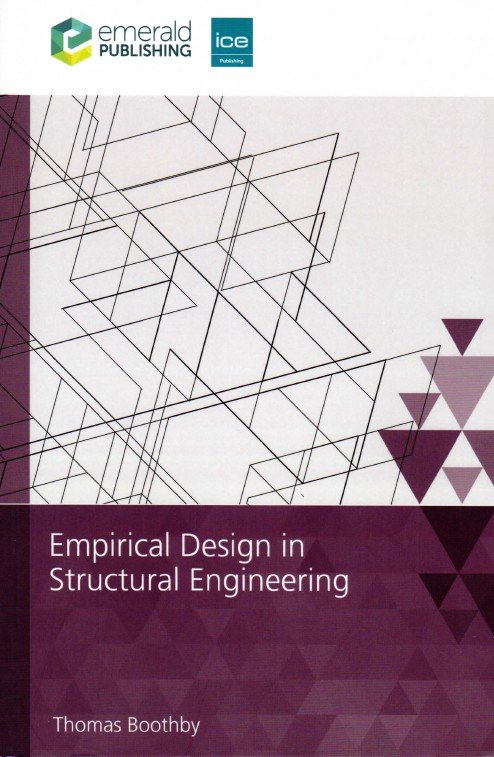
At the conference in Providence, I met the author Professor Thomas Boothby, of Penn State University. I learned he was the author of Engineering Iron and Stone: Understanding Structural Analysis and Design Methods of the Late 19th Century. I’ve appreciated that book for several years but in my conversation with Professor Boothby, he suggested that his more recent book Empirical Design in Structural Engineering desired more recognition. He was kind enough to share a copy of his most recent book.
I’ve completed reading the book and I must admit that it offers compelling arguments to support utilization of empirical design for structures. The book presents what should be obvious to all of us, that the analytical design process is a very recent development as compared to to the empirical design process which was the only process for a couple of millennia.
The book was fascinating as it delved into the relationship, and logic, that many of the existing building codes are based on empirical theory and only marginally supported by analytical research.
I was particularly interested in chapter 7, Case Study 1: Empirical design in historic structure assessment and preservation. To get a complete understanding of the author’s message, it was important that I read the preceding chapters.
Among other take away, I appreciated learning the transition from purely empirical design to analytical rational design as we are working on several projects designed during that period in history.
I agree with the author that empirical design is essential at the onset of projects as a basis from which to develop a successful design solution. I also agree with the author’s concern regarding the means by which to educate engineering students as to education gained by experience.
This is not a light reading, but in my opinion is well worth the investment of time if you are an engineer or working with historic structures as an architect or engineer.

About the AUthor
Thomas Boothby is a professor of Architectural Engineering at the Pennsylvania State University. He is a registered architect and professional engineer with 40 years of experience in structural engineering as a designer and educator. He is the author of multiple books like Engineering Iron and Stone: Understanding Structural Analysis and Design methods of the late 19th century, and Empirical Structural Design for Architects, Engineers and Builders.
This book is available from Emerald Insight
This book is available from Vital Source
P.S. Please feel free to send me your comments on Empirical Design in Structural Engineering or other books that you believe are essential for preservationist!